The Devil Tarot Card Meaning: Attachment, Temptation and the Patterns That Keep Us Stuck
Quick Answer
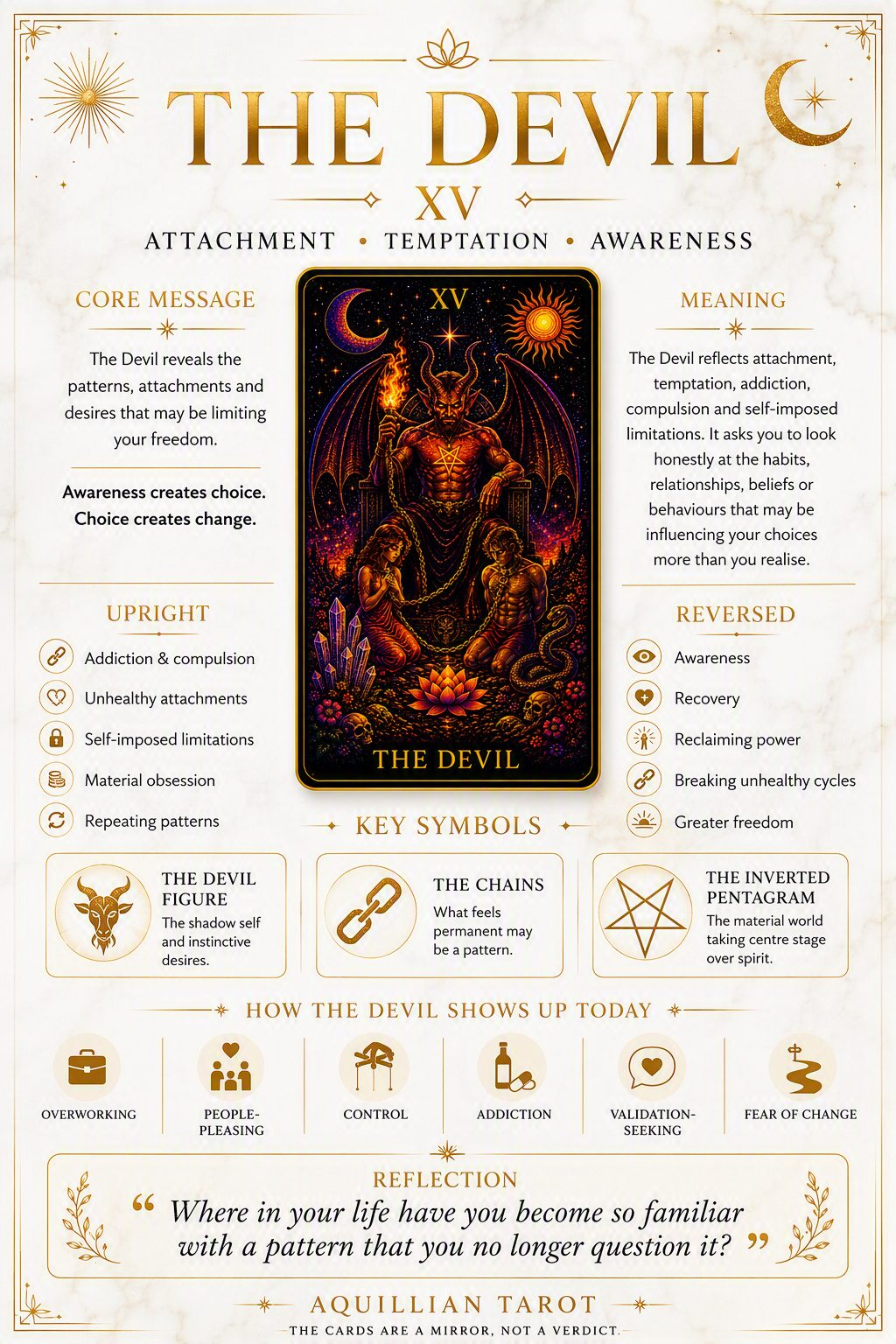
The Devil tarot card represents attachment, temptation, addiction, compulsion, materialism and self-imposed limitation. In traditional tarot, this card asks us to honestly examine the habits, relationships, beliefs and behaviours that may be limiting our freedom or influencing our choices more than we realise.
Despite its intimidating reputation, The Devil is not a prediction of misfortune. It is a mirror. It highlights the places where fear, desire, comfort, control or habit may be running quietly in the background of our lives.
When The Devil appears, the question is rarely:
"What terrible thing is about to happen?"
The question is far more interesting:
"What pattern is asking to be seen clearly?"
Table of Contents
What Does The Devil Tarot Card Mean?
The Devil Is Not A Punishment Card
The Symbolism of The Devil Tarot Card
Upright Devil Tarot Card Meaning
The Devil, Addiction and Compulsion
Reversed Devil Tarot Card Meaning
The Devil in Love Readings
The Devil in Career and Money Readings
The Devil and Capricorn
How to Work with The Devil Card
Journal Prompts for The Devil
Frequently Asked Questions
Final Thought
What Does The Devil Tarot Card Mean?
The Devil is card XV of the Major Arcana.
It is one of the most recognised cards in the deck. And one of the most misunderstood. The imagery tends to do that.
The Devil often appears when we are dealing with attachment, temptation, unhealthy patterns, addiction, fear, obsession, control or the illusion that we have fewer choices than we really do.
This card traditionally explores the tension between freedom and attachment. Between conscious choice and automatic behaviour. Between participation and control.
The Devil does not usually appear because something outside of you suddenly has power over your life. More often, it appears when a habit, relationship, belief, desire or fear has gradually been given more influence than it deserves. That can sound confronting. It can also be incredibly useful. Because once a pattern becomes visible, it can be examined. And anything that can be examined can be understood.
Sonic Mirror
If The Devil were a song, it might be Sweet Dreams (Are Made of This) by Eurythmics.
That looping rhythm.
That magnetic pull.
That feeling that something is both fascinating and difficult to walk away from.
Take a breath.
Listen to the beat.
Then ask yourself:
What keeps calling for my attention, even when I already know the song by heart?
The Devil Is Not A Punishment Card
The Devil often gets cast as the villain of the Major Arcana. Fair enough.
The horns are not exactly subtle. But despite the dramatic styling, this is not a punishment card. It does not appear because you have failed. It does not arrive to shame you. And it certainly does not arrive to predict doom.
The Devil is a mirror. A very honest one.
This card shines a light on the places where desire, fear, habit, comfort, status, validation or control may have become louder than your conscious choices.
That can feel uncomfortable. Most mirrors are. But discomfort and punishment are not the same thing. One of the reasons The Devil remains so powerful is that it asks us to look at something many of us would rather avoid:
Where am I participating in a pattern that is limiting my freedom?
Not because you're weak. Not because you're broken. Because you're human.
The card does not take your power away. It asks where your power may have become tangled up in a habit, a fear, a relationship, an expectation or a version of yourself that no longer fits.
The question isn't:
"What have I done wrong?"
The question is:
"What am I ready to see clearly and do different?"
The Symbolism of The Devil Tarot Card
Traditional tarot imagery presents The Devil seated above two chained figures. The chains are one of the most important details in the card. Not because they symbolise imprisonment alone. Because they symbolise attachment. The figures remain connected to what binds them.
The card invites us to consider:
What are we attached to?
Why are we attached to it?
What are we receiving from the attachment?
What is the attachment costing us?
The Devil speaks to the complicated relationship humans have with desire.
Desire itself is not the problem.
Ambition isn't the problem.
Pleasure isn't the problem.
Security isn't the problem.
The challenge begins when any of these things become the quiet decision maker behind our choices.
The Devil asks us to notice the difference.
Upright Devil Tarot Card Meaning
In its upright position, The Devil highlights attachment, temptation, unhealthy habits, dependency, obsession and self-imposed limitation.
Sometimes those limitations are obvious.
Sometimes they hide behind perfectly respectable disguises.
· Work ethic.
· Perfectionism.
· Being needed.
· Being productive.
· Being successful.
· Being right.
· Being comfortable.
The upright Devil asks us to examine whether something in our lives has begun taking more than it gives.
Perhaps a habit that once provided relief.
A relationship that once felt exciting.
A goal that once felt meaningful.
A belief that once felt protective.
This card rarely arrives to judge.
It arrives to reveal.
Where in your life does a pattern keep repeating, even though part of you already knows it is no longer helping you move forward?
The Devil, Addiction and Compulsion
One of the oldest and most enduring interpretations of The Devil is addiction.
Sometimes that addiction is literal.
Sometimes it is psychological.
Sometimes it is emotional.
The card can appear around alcohol, gambling, substances, spending, unhealthy relationship dynamics, compulsive behaviour, work obsession, perfectionism, people-pleasing or the endless search for approval.
The specific attachment matters less than the pattern underneath it.
Because The Devil rarely asks:
"What are you attached to?"
It asks:
"What has started making decisions on your behalf?"
This is where the card becomes especially confronting.
Not because it judges us. Because it asks for honesty.
The relationship that keeps repeating the same ending.
The extra drink that quietly became routine.
The achievement that never quite feels like enough.
The scrolling that was supposed to be ten minutes and somehow became an hour.
The need to stay productive.
The need to stay busy.
The need to stay liked.
The need to stay comfortable.
The Devil recognises that attachments are rarely random.
Every attachment offers something.
Comfort.
Relief.
Validation.
Control.
Certainty.
Temporary protection from a feeling we'd rather not experience.
That is why breaking a pattern is often more complicated than simply deciding to stop.
Because if an attachment is providing comfort, even unhealthy comfort, the deeper question becomes:
What is this attachment protecting me from feeling?
Now we're having a Devil conversation.
The spending might be about security.
The overworking might be about worthiness.
The people-pleasing might be about rejection.
The control might be about fear.
The habit might be helping us avoid grief, disappointment, uncertainty or vulnerability.
The Devil invites us beneath the surface.
Not to shame the pattern.
To understand it.
Because understanding creates awareness.
And awareness creates choice.
The attachment may not disappear overnight.
The habit may not immediately lose its grip.
The fear may not suddenly leave the building.
But something important changes the moment the pattern becomes visible.
The card is not asking whether freedom will happen instantly.
The card is asking:
Where in your life has a coping mechanism quietly become a cage?
Reversed Devil Tarot Card Meaning
When The Devil appears reversed, attention often shifts toward awareness, release, recovery and renewed personal agency.
This does not necessarily mean the issue has fully disappeared.
The pattern may still be present.
The attachment may still exist.
The habit may still require attention.
But something has changed.
The relationship to it is becoming conscious.
In a reading, The Devil reversed may point to:
increased self-awareness
breaking an unhealthy cycle
recovery from addiction
recognising a limiting belief
reclaiming personal power
loosening an attachment
establishing healthier boundaries
Awareness often arrives before freedom.
The reversed Devil frequently appears in that in-between space.
The moment when someone realises the chain exists.
And begins considering whether they still want to carry it.
What pattern has become impossible to ignore?
The Devil in Love Readings
In love readings, The Devil often relates to attraction, chemistry, obsession, dependency, control, attachment and power dynamics.
Sometimes the card reflects intense physical attraction.
Sometimes it reflects a relationship dynamic that feels difficult to leave.
The card invites attention toward:
possessiveness
jealousy
dependency
emotional entanglement
repeating relationship patterns
attraction that overrides good judgement
attachment disguised as love
The Devil does not automatically mean a relationship is unhealthy.
It asks a more useful question:
Do you feel increasingly free to be yourself within this connection, or increasingly constrained by it?
That distinction matters.
The Devil in Career and Money Readings
In career readings, The Devil often appears around ambition, work attachment, burnout and material pressure.
It can point toward:
overwork
unhealthy workplace dynamics
career identity becoming all-consuming
status-driven decisions
fear of change
financial dependency
"golden handcuffs"
Money itself is not the issue.
Success itself is not the issue.
The card asks whether the pursuit of these things has quietly become the thing driving every decision.
The Devil reminds us that security matters.
But so does freedom.
What are you working for, and when was the last time you checked whether the cost still feels worthwhile?
The Devil and Capricorn
The Devil is traditionally associated with Capricorn. This connection is not about negativity.
It reflects themes of ambition, structure, discipline, responsibility and material reality.
Capricorn understands how to build. How to commit. How to persevere.
The shadow side of this energy appears when achievement becomes identity.
When productivity becomes self-worth. When success becomes the only measure of value. The Devil asks us to examine where structure supports us and where structure may be limiting us.
A useful distinction.
How to Work With The Devil Card
Working with The Devil is not about fighting yourself. The card responds far better to curiosity than criticism. A simple reflection practice might begin with three questions:
What is the pattern?
Name it plainly.
Not the polished version.
The honest version.
What does it give me?
Every attachment offers something.
Comfort.
Relief.
Distraction.
Validation.
Security.
Control.
What does it cost me?
Time?
Energy?
Confidence?
Money?
Peace?
Freedom?
Honest answers create clarity.
And clarity often creates movement.
Journal Prompts for The Devil
Let the answers be honest before they are polished.
That is usually where the good stuff lives.
What am I repeatedly returning to, even when it is no longer giving me what I truly need?
Which parts of my life feel consciously chosen, and which feel automatic?
What comfort does this attachment provide me?
What is the real cost of maintaining it?
What fear sits underneath this habit, behaviour or relationship?
Where am I seeking certainty at the expense of freedom?
What part of my identity feels tied to this pattern?
What would I have to feel if this coping mechanism was no longer available to me?
Which story about myself have I outgrown but continue to carry?
Where do I feel trapped, and what evidence suggests there may be more choice available than I currently believe?
What am I protecting, preserving or avoiding through this attachment?
If this pattern could speak, what would it say it has been trying to do for me?
What is the next honest truth waiting patiently for my attention?
Frequently Asked Questions
Is The Devil tarot card always bad?
No. The Devil is not automatically a negative card. It often highlights attachment, temptation, addiction, unhealthy habits, fear or limiting beliefs. The value of the card comes from its ability to reveal patterns that may otherwise remain unconscious.
Does The Devil tarot card mean addiction?
Sometimes. Addiction is one of the traditional meanings of The Devil, but the card can also represent psychological attachment, emotional dependency, compulsive behaviour, obsession, fear or self-limiting beliefs.
What does The Devil reversed mean?
The Devil reversed often points toward awareness, release, recovery, personal agency and the gradual loosening of a limiting pattern or attachment.
What zodiac sign is associated with The Devil?
The Devil is traditionally associated with Capricorn.
Is The Devil a warning card?
Not in the sense of predicting doom or misfortune. The Devil highlights patterns that deserve attention. It functions as a mirror rather than a punishment.
What is the difference between The Devil and The Tower?
The Devil usually reflects attachment, participation and patterns that keep us stuck. The Tower often represents sudden disruption or change. The Devil shows the chain. The Tower shows what happens when the structure can no longer hold.
Final Thought
The Devil is not asking whether you're good.
The Devil is not asking whether you're bad.
The Devil is not especially interested in labels.
It's interested in patterns.
In habits.
In attachments.
In the quiet bargains we make when certainty feels safer than change.
The card offers a mirror.
Nothing more.
Nothing less.
What you choose to do with that reflection remains entirely yours.
The chains may be familiar.
The question is:
Are they still helping you move, or have they simply become part of the scenery?
